
Prodotti
Matrice titanizzata per la chirurgia del seno TiLOOP Bra Pocket

TiLOOP® Bra Pocket

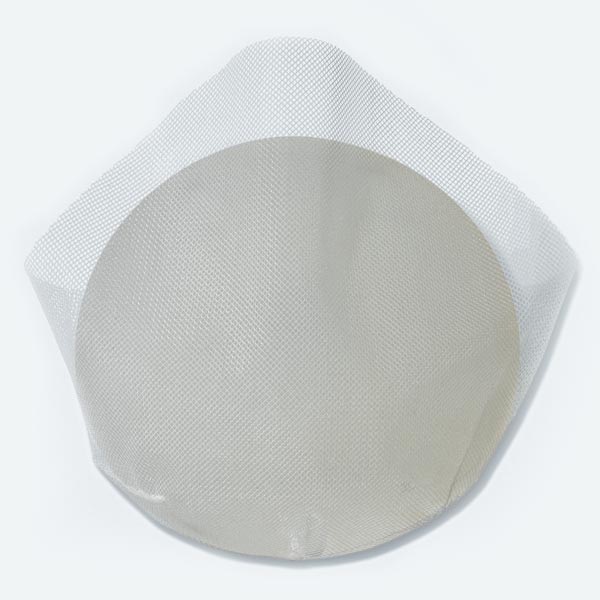
Matrice bioinerte titanizzata 3D per la chirurgia ricostruttiva prepettorale

In presenza di una neoformazione maligna della mammella e spesso anche quando c’è un forte rischio che si sviluppi un tumore vengono eseguiti interventi demolitivi di vario tipo, in rapporto allo sviluppo della malattia e alla strategia terapeutica prescelta.
La ricostruzione può essere immediata cioè eseguita durante lo stesso intervento demolitivo oppure può essere differita e cioè eseguita in un secondo tempo, a distanza di 6-9 mesi dopo il primo intervento.

Dall’esperienza maturata con decine di migliaia di interventi eseguiti con la matrice titanizzata TiLOOP® Bra Pocket, siamo orgogliosi di presentarne l’evoluzione:
l’unica rete tridimensionale sintetica presagomata sul mercato approvata appositamente per la ricostruzione del seno dopo mastectomia con posizionamento pre-pettorale.

Il rivestimento in titanio aumenta notevolmente la biocompatibilità con i tessuti ed è proprio per questa sua caratteristica che da decenni è impiegato in altre branche della medicina.

Essa consente di posizionare la protesi mammaria immediatamente dopo la rimozione della massa tumorale evitando così il posizionamento dell’espansore temporaneo e successivamente, del secondo intervento.

Mesh titanizzata Chirurgia del seno TiLOOP Bra Pocket

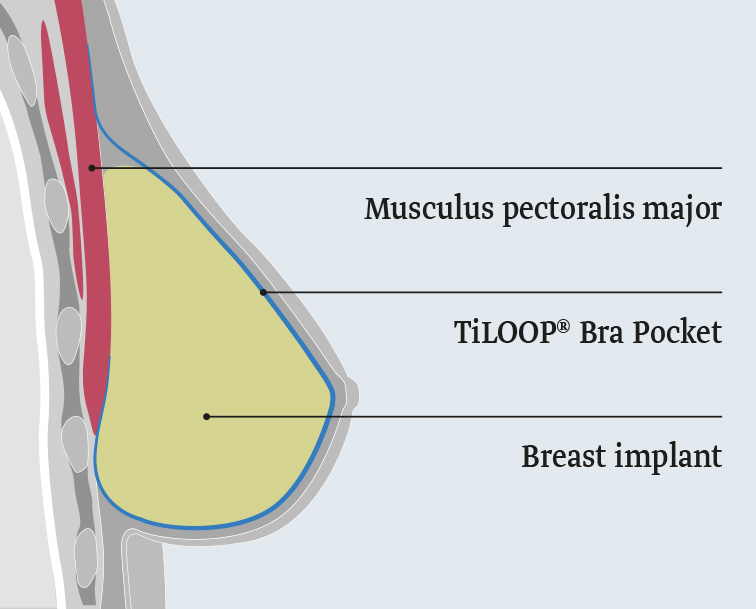
La TiLOOP® Bra Pocket accoglie l’impianto protesico rivestendolo integralmente, il muscolo non viene sollevato come avveniva con al tecnica dual-plane, non rimane altro che inserire la Pocket contenete la protesi e fissarla con dei punti di sutura al muscolo pettorale.

Mesh titanizzata Chirurgia del seno TiLOOP Bra Pocket

Impianto con TiLOOP® Bra Pocket

Applicazione dell’mpianto protesico.
Il rivestimento brevettato in Titanio e la sua leggerezza garantiscono un’ottima biocompatibilità ed il massimo comfort per il paziente.
TiLOOP® Bra Pocket è disponibile in diverse dimensioni

Mesh titanizzata Chirurgia del seno TiLOOP Bra Pocket

Per la scelta della misura più appropriata, richiedere la scheda tecnica ove si trovano maggiori informazioni in base alla proiezione e al volume dell’impianto protesico.

MisureLargh. impianto (A)Largh. impianto (B)Volume impianto
SMALL< 11 cm< 4,5 cm< 270 ml
MEDIUM< 13 cm< 5,5 cm< 420 ml
LARGE< 15 cm< 6,5 cm< 550 ml
ArticoloDescrizionePeso g/m2Pezzi/Conf.
60001383TiLOOP® Bra Pocket small extralight161
60001385TiLOOP® Bra Pocket medium extralight161
60001387TiLOOP® Bra Pocket large extralight161
Contattaci per avere informazioni sul prodotto e ordinarlo
Compila il form

Chiamaci

T +39 02 87282900

Approfondimenti scientifici

Titanizzazione: la creazione di un materiale combinato
2025

Titanio: in medicina da oltre 70 anni

Il titanio è uno dei materiali più biocompatibili ed utilizzato in varie applicazioni chirurgiche sin dal 1946. Con le sue eccezionali caratteristiche meccaniche come la leggerezza e l’elevata resistenza alla trazione, soddisfa anche le massime esigenze per gli impianti in medicina. Tramite le tecnologie moderne si è riusciti a legare questo materiale a quello plastico delle mesh chirurgiche in modo indissolubile.

Il risultato è la creazione di un nuovo materiale che combina i vantaggi del titanio e del polipropilene.

Mesh titanizzata

Eccellente biocompatibilità

È la caratteristica biochimica del Titanio, materiale usato con successo in numerose specialità chirurgiche.

Nel 2002 pfm medical ha sviluppato con successo la prima procedura a livello mondiale che consente l’applicazione del titanio su materiali primari flessibili ed elastici, in particolare matrici di polipropilene.

Il polipropilene è stato scelto tra i vari materiali primari su cui procedere col processo di titanizzazione perché meglio risponde alle caratteristiche di flessibilità ed elasticità.

Confronto della carica energetica della superficie

Materiale non titanizzato vs materiale titanizzato.
L’energia di superficie misura l’idrofilia e quindi la biocompatibilità corporea ad un materiale.

Biocompatibilità Mesh titanizzata

Zimmermann et al.; Medizintechnik
Life Science Engineering (2008)
10.1007/978-3-540-74925-7

Il nostro sistema immunitario reagisce ogni volta che rileva corpi estranei. Le proteine come le albumine, venendo a contatto con superfici idrofobiche, assumeranno forme così innaturali, da attivare le cellule del sistema immunitario, ad es. macrofagi e linfociti B, le quali alimentano la risposta infiammatoria terminando con la formazione del tessuto cicatriziale. Nel caso in cui le proteine, si leghino invece a corpi estranei ma con superficie idrofilica come le matrici titanizzate, non modificheranno la forma innescando una minima risposta infiammatoria dovuta ad una risposta del sistema immunitario non così marcata.

Scarica la brochure e contattaci per saperne di più.

Breast reconstruction with TiLOOP® Bra: Another arrow in plastic surgeons’ quiver?
2024 - Annachiara Tellarini, Elisa Bascialla, Ferruccio Paganini, Veronica Fasoli, Francesco Buttarelli, Eduardo Paolo Marra, Federico Tamborini, Martina Corno, Danilo Di Giovanna, Roberto Baraziol, Maria Flocchini, Laura Maria Curic , Adriana Tuttolomondo, Sarah Calabrese, Luigi Valdatta

Background: 

The use of lower-pole sling products has made immediate breast reconstruction a feasible option in women undergoing skin-nipple sparing and skin-reducing mastectomies. To date, available data on the comparative efficacy of biological and synthetic meshes regarding postoperative complications are scattered and limited.

Study results

A systematic literature search was performed to screen three different databases (PubMed, Web of Sciences, and Embase) using the following keywords: “breast reconstruction” AND “TiLOOP®” OR “Titanium-Coated Polypropylene Mesh” OR “TCPM”. The perioperative and demographic characteristics of patients, complications profiles, and patient-reported outcomes were considered.

We initially identified 234 articles, of which only 41, including 3923 patients and 5042 reconstructed breasts, fully satisfied the inclusion criteria

Conclusion: 

TiLOOP® Bra could be considered a safe and aesthetically valid alternative to Acellular Dermal Matrices (ADMs) in non-smokers patients undergoing skin-nipple sparing and skin-reducing mastectomies and immediate reconstruction. The incidence of seroma with TiLOOP® Bra is comparable to that of ADMs as it is the beneficial effect in radiated patients, where TiLOOP® Bra seems superior to implant alone reconstruction. It has a good bio-integration with host tissues and resistance to infections in patients with a weakened immune system as a consequence of oncologic perioperative treatments.

Implant Based Breast Reconstruction Using a Titanium-Coated Polypropylene Mesh (TiLOOP® BRA): A systematic review and Meta analysis
2023 - Tingjian Zhang, Jing Ye, Tian Tian

Background: 

Implant-based breast reconstruction (IBBR) can be performed using a variety of biological and synthetic meshes. However, there has yet to be a consensus on the optimal mesh. This study investigates the safety and patient satisfaction of using TiLOOP® Bra in IBBR and compares its postoperative complication risk with that of porcine acellular dermal matrix (ADM) and SERAGYN BR.

Study results

The literature review was performed via PRISMA criteria, 23 studies met the inclusion criteria for the TiLOOP® Bra review, and 5 studies met the inclusion criteria for the meta-analysis. Patient characteristics and per-breast complications were collected. Data were analyzed using Cochrane RevMan and IBM SPSS.

Conclusion: 

The meta-analysis revealed that TiLOOP Bra has better safety than ADM, and the TiLOOP® Bra group had a significantly lower incidence of seroma formation compared to the SERAGYN BR group.

Titanium-coated polypropylene mesh as innovative bioactive material in conservatives mastectomies and pre-pectoral breast reconstruction
2021 - Pietro Gentile, Marco Bernini, Lorenzo Orzalesi, Silvia Sordi, Icro Meattini, Francesca Lessi, Ashutosh Kothari e Claudio Calabrese

Background: 

Breast reconstruction is rapidly evolving, thanks to the growing acceptance of synthetic meshes as innovative biomaterials. 276 patients undergoing mastectomy (total of 328 mastectomies) were analyzed in a retrospective observational study to evaluate the pre-pectoral immediate breast reconstruction (IBR) using an implant wrapped with Titanium-Coated Polypropylene Mesh (TCPM) vs. patients treated with tissue expander (TE), equally placed pre-pectorally (and wrapped with the same TCPM in 74.3% of the control group’ breasts). 

Study results

Histological analysis showed a process of normal tissue repair with a complete mesh integration and normal healing. Conservative mastectomies with pre-pectoral IBR assisted by TCPM proved themselves oncologically safe, biologically integrated into native tissues, and highly accepted in terms of quality of life guaranteeing a more natural and aesthetic breast appearance.

Conclusion: 

This retrospective observational study provided clinical and histological outcomes of the pre-pectoral IBR using an implant wrapped with TCPM vs. patients treated with TE, equally placed pre-pectorally.

All the histological analyses performed confirmed the TCPM mesh complete integration with the physiological aspects of healing: The Collagen 1 and 3 expressions did not differ, between TCPM and NO TCPM samples to confirm a process of healing overlapping to perfect device incorporation and normal healing.

“To Pre or Not to Pre”: Introduction of a Prepectoral Breast Reconstruction Assessment Score to Help Surgeons Solving the Decision-Making Dilemma. Retrospective Results of a Multicenter Experience
2021 - Donato Casella, Juste Kaciulyte, Federico Lo Torto, Francesco L. R. Mori, Leonardo Barellini, Alfonso Fausto, Benedetta Fanelli, Manfredi Greco, Diego Ribuffo, Marco Marcasciano

Background: 

Implant-based reconstruction is the most performed breast reconstruction, and both subpectoral and prepectoral approaches can lead to excellent results. Choosing the best procedure requires a thorough understanding of every single technique, and proper patient selection is critical to achieve surgical success, in particular when dealing with prepectoral breast reconstruction

Study results

352 patients were included; 112 of them underwent direct-to-implant immediate reconstruction, and 240 underwent the two-stage procedure with temporary tissue expander. In both cases, the implant was wrapped in a titanium-coated polypropylene TiLoop Bra. According to the Prepectoral Breast Reconstruction Assessment score, direct-to-implant reconstruction should have been performed 6.2 percent times less, leading to an increase of 1.4 percent in two-stage reconstruction and 4.8 percent in submuscular implant placement.

Conclusion: 

To date, there is no validated system to guide surgeons in identifying the ideal patient for subcutaneous or retropectoral breast reconstruction and eventually whether she is a good candidate for direct-to-implant or two-stage reconstruction. The authors processed a simple risk-assessment score to objectively evaluate the patient’s risk factors, to standardize the decision-making process, and to identify the safest and most reliable breast reconstructive procedure

Prepectoral breast reconstruction with TiLoop® Bra Pocket: a single center prospective study
2020 - F. LO TORTO, M. MARCASCIANO, J. KACIULYTE1, U. REDI, L. BARELLINI, A. DE LUCA, A. PERRA, J.M. FRATTAROLI, E. CAVALIERI, G. DI TARANTO, M. GRECO, D. CASELLA

Background: 

The aim of this paper is to describe our case series in IBR with prepectoral implant placement and complete cover- age of it with the TiLoop® Bra titanium-coated poly- propylene mesh (TCPM), pre-shaped as a pocket. 

Study results

This preliminary study showed meaningful results in prepectoral IBR with TiLoop® Bra Pocket covering the implants, we observed a reduction of implant’s exposure time and risk of bacterial contamination. Of the 18 pa- tients that underwent this procedure, only three presented complications that resolved in a maximum of four weeks.

Conclusion: 

A considering reduction of surgical time in implant positioning was achieved, lowering exposure time and risk of complications as infection.

Mesh versus acellular dermal matrix in immediate implantbased breast reconstruction. A prospective randomized trial
2016 - D. Gschwantler-Kaulich, P. Schrenk, V. Bjelic-Radisic, K. Unterrieder, C. Leser, A. Fink-Retter, M. Salama, C. Singer

Mesh versus acellular dermal matrix in immediate implantbased breast reconstruction. A prospective randomized trial

This prospective, randomized, controlled, multicenter pilot study was performed at four Austrian breast cancer centers. Fifty patients with oncologic or prophylactic indication for mastectomy and IBBR were randomized to immediate IBBR with either an ADM(Protexa) or a titanized mesh (TiLOOPBra).

Da evidenziare sia il 30% di perdita di impianto nel gruppo di Protexa(contro il 7 % di tiloop),sia il miglior outcome estetico e grado di soddisfazione del gruppo Tiloop BRA.